Martial Arts How Much Energy Is Delivered in a Side Kick
| Front kick | |||||||
|---|---|---|---|---|---|---|---|
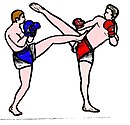 A counter-attack with a front kick in burmese battle | |||||||
| Korean proper name | |||||||
| Hangul | 앞차기 | ||||||
| Hanja | none | ||||||
| |||||||
| Japanese name | |||||||
| Kanji | 前蹴り | ||||||
| Hiragana | まえげり | ||||||
| |||||||
The front kick in martial arts is a kick executed by lifting the knee straight forwards, while keeping the foot and shin either hanging freely or pulled to the hip, then straightening the leg in front of the practitioner and hit the target expanse. Information technology is desirable to retract the leg immediately after delivering the kicking, to avoid the opponent trying to grapple the leg and (unless a combination is in process) to return to stable fighting stance.
The front kick described is the typical basic forepart kicking of karate or taekwondo. Merely the front end kick tin can besides be divers more broadly as a straight forward kicking straight to the forepart, and and so include several variations from many different styles. A forepart kicking tin be delivered forward in a penetrating manner (hip thrust), or upward to assail the head.
Details of the technique [edit]
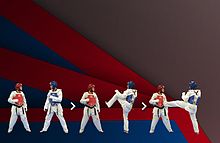
In martial arts implying either barefooted combat or very lite footwear, the strike is unremarkably delivered by using brawl of the human foot (while pointing the human foot toward the target expanse and keeping toes upwards to prevent injury) or past heel. When heavier footwear is used, at that place is an option using whole sole as a hit surface. It is also possible to boot with the top of the pes (the instep) in cases of striking at the groin or nether the arm which can be very dissentious.
Using ball of a foot is preferred in karate. This method demands more than control of 1's movement, merely allows for narrow, penetrating strike. Taekwondo practitioners utilise both heel and ball of the foot for hitting. It is common to perform tempering exercises to strengthen ball of the foot, as many new practitioners are unable to exercise full-power front kicks on grooming gear, such every bit body bag.
With specific techniques and in certain styles, the touch indicate of the front kick tin be more exotic. Certain Japanese styles have a front end boot generally used equally a end-kicking where the blade of the foot is used to connect, similar for a side kick (the foot blade front end boot). The heel is often used directly ( mae kakato geri ) or with the human foot tilted (tilted heel front end kick), especially in finish-kicks, close kicks or high front kicks. Japanese nin-jitsu[ clarification needed ] has variations using the straightened and hardened toes. Front end kicks to the groin ({{transl|ko|kin geri[ description needed ]) like the lift kick or the upward front end kick ( mae geri keage ), use the acme of the human foot. The phantom groin boot uses the whole of the inside of the foot to connect very effectively. End kicks oftentimes use the whole plant of the foot to push button away the opponent.[1]
Various combat systems teach 'general' front kick using heel or whole human foot when footwear is on. For instance, martial art systems employed by military assume that a fighter wears heavy footwear, is generally less mobile than typically causeless in competition martial arts, and may have his/hers leg muscles severely fatigued. Properly executing fast 'snap' front kicking while controlling 1's foot direction may be difficult in said weather. Less technically demanding kick utilizing sole of heavy footwear as a striking surface is easier to execute.

The forepart kick is typically performed with the directly and balanced upper body, merely it allows for variety in motion of hips and trunk overall. Martial arts systems exploit this ability in different fashions. For example, a karateka may perform mae geri while standing upright, or lean somewhat back during the attack, intending to increase the reach of the kick. If a simple 'kick-dial' combination is executed, this slight lean allows for more momentum placed into the movement of upper body, thus the karateka will end with a more powerful body movement backside the punch. The contrary situation is exploited in some variations of Fly Chun, where potent forward motion of both hands blocking/hitting in upper surface area could exist accompanied with a slight leaning forward and simultaneous front kick into groin/thigh, etc. Hips movement may exist used to increase the achieve and to thrust 1's leg into the target, resulting in more powerful strike (a mutual practice in taekwondo and some styles of karate).
Applications and counters [edit]

Front kicks are typically aimed at targets below the breast: stomach, thighs, groin, knees or lower. Highly skilled martial artists are often capable of striking head-level targets with front kicking (albeit rarely use it this mode). The front kicking is fast and involves lilliputian body motion betraying the technique's nature prior to execution. This makes a well-adult forepart boot an excellent nugget in both offence and defense.
When defending, front kick could be used to severely damage the lower area of the opponent who has started an assault, but has overconcentrated on guarding head/upper body, and as a expert tool to go on enemy from punch range. In offense, front kick could serve equally an fantabulous opener for combination attacks, as it is fast, unsafe plenty for opponent to switch attention to block/deflecting/evading the kick, but requires little deviation from the upright fighting opinion, which is good to start punch assault from. Overall, at that place is a wide diverseness of situations where this kick could be exploited past a creative martial arts practitioner.
Common ways to counter a front kicking are deflecting it with manus, shin, etc., stepping away/sideways, or, given the kick is visibly pointed into belly/thighs area, shifting a body then information technology passes along. The terminal method is somewhat risky, as it relies heavily on defender's agility, with a front end kicking being one of the fastest kicks possible. More exotic techniques of countering front end kicks exist, like one incorporated in Wado ryu kihon kumite (referred to as yakusoku , or prearranged, kumite, in some schools). Said technique involves simultaneously pushing opponents leg abroad from one's centerline and attacking the leg with a downward elbow strike into the hip. However, this method is not recommended to beginners and as a general purpose one.
Too, although well-executed front kick is very fast, a devil-may-care execution presents an opponent with excellent opportunity for grappling, which could be disastrous for an attacker. Once the leg is grappled, a diverseness of attacks is available to a defender, such every bit wrestling techniques resulting in hurting compliance hold, immediate counterattack with punches, throws, kicks into lower area and combinations of all above. For this reason, 'recocking' the leg after the kick is truly important, especially in existent-life situations, where rules mutual to many competition martial arts do non apply. Notwithstanding, executing front kicks to the waist and below is relatively rubber and effective, given the leg is immediately retracted.
In Tae Kwon Do [edit]
In taekwondo, the front boot bears the name ap chagi . It is distinct from the push button kick ( mireo chagi ) in that the power should be delivered instantaneously. Since the leg moves forrard while the shin and pes naturally swing up, the easiest awarding of this boot is that of directing one's energy upwards, possibly considering it a "kicking to the groin". Even so, 1 tin deliver massive strength forward with this kick as well, which is considered its main application by most instructors. Directed forward, this is actually i of the most powerful kicks in Taekwondo, and it is quite often used in exhibitions and board-breaking competitions where power is demonstrated.
In guild to not injure ones toes while executing this boot, it is usually delivered through the front base of the foot ( ap chook ), if non with the flat upper side of the foot ( bal deung ). If performed with the bare foot then the brawl of the foot is used on impact with the toes drawn upward to forestall injury. To strike with ap chook one has to raise i's toes so that their tips will not be the first contact bespeak. Even when directed forrard, this is not a kick where the first contact betoken should be the base of operations of the heel, equally is considered beneficial in another martial arts having a like boot. In Taekwondo, one would strike forrad with the talocrural joint extended, so that the upper side of the foot forms a straight line with the shin, and with the toes bent back (pointing up). In other words, an " ap chook ap chagi ". Having the foot in any other position when directing this kick strictly forward would be considered highly unorthodox, and is a common error among beginners.
In addition to beingness a kick in itself, the front kick is an exercise used past many instructors to teach the principle of lifting ones knee before the remainder of the kick commences, something which is considered of import in taekwondo, where it is somewhat literally translated from the Korean ap chagi (앞차기), (and many kick arts with the notable exception of capoeira). In competition fights (known every bit "sparring" or " kyorugi ") this boot sees little actual employ, except mayhap every bit a component in an improvised kick which is peradventure intended as an " an chagi " or " naeryo chagi ".
It is common to slightly bend the knee of the leg one is standing on when executing this kick, and pointing the foot one is continuing on somewhat outwards. As in all taekwondo kicks, one will likewise try to get ones "hip into the kick", resulting perhaps in a slight shift of weight forward. In any case, this is a linear kick, and equally such ane that one tin can become ones weight backside.
At that place exist countless variations of this kick, and it can exist used along with other kicks without one having to put ones kick foot down in betwixt kicks. A very mutual variation is " ttwimyeo ap chagi ", a flying front kick which can reach an impressive tiptop.
Some instructors refer to this kick equally the "flash boot". This is in tune with the line of thought which seems prevalent in the various taekwondo forms, where the ap chagi is used very extensively in combination with relatively short range paw strikes and blocks, mimicking situations in which it would have to be performed quite chop-chop.
Karate [edit]
The front kick, chosen mae geri in Japanese, is certainly the main boot in traditional karate of all styles. It is the most used kicking in traditional kata forms and the nigh proficient kicking in traditional kihon exercise. The boot is a very strong and fast strike, and easier to primary than less "natural" kicks. The kick generally connects with the brawl of the human foot, under the toes, but other points of touch on are sometimes used in the many variants existing in Japanese karate and other styles. It can exist thrusting ( kekomi ) or snapping ( keage ), or somewhere in between. In its thrusting or kekomi form the kicker pushes the foot into the target powerfully leveraging the momentum of his own body weight in order to propel the opponent or target backwards. In its snapping or keage form the kicker emphasizes the extremely quick retraction or recoil or re-chamber of the foot and the lower leg immediately after bear on (thereby making it difficult to catch or grab the leg by the opponent); The keage kick exhibits less pushing force but more breaking bear on than the kekomi form of the kick. Information technology can be delivered with hopping ( surikonde ) or jumping ( tobikonde ), and sometimes with a direct leg all-the-way ( mae keage ). It tin be executed with the front leg, defensively or hopping frontward, or the rear leg. It tin be executed with almost foursquare hips, or with hips lined sideways like the yoko geri of Wado-ryu Karate. There are many other variations, every bit the kick can also exist feinted, angled or delivered from the ground.[2]
Come across also [edit]
- Kick
- Korean martial arts
- Standing leg press exercise
Notes [edit]
- ^ De Bremaeker, One thousand. et al., The Essential Book of Martial Arts Kicks: 89 Kicks from Karate, Taekwondo, Muay Thai, Jeet Kune Do, and others (Tuttle Publishing, 2010), p. 23. ISBN 0-8048-4122-five
- ^ De Bremaeker, M. et al., The Essential Book of Martial Arts Kicks: 89 Kicks from Karate, Taekwondo, Muay Thai, Jeet Kune Exercise, and others (Tuttle Publishing, 2010), p. 25. ISBN 0-8048-4122-5
References [edit]
- Scott Shaw (2006). Avant-garde Taekwondo. Tuttle Publishing. p. 45. ISBN0-8048-3786-four.
- Woo Jin Jung (1999). Freestyle Sparring. Jennifer Lawler. p. 22. ISBN0-7360-0129-viii.
- De Bremaeker, M.; et al. (2010). The Essential Book of Martial Arts Kicks: 89 Kicks from Karate, Taekwondo, Muay Thai, Jeet Kune Practice, and others. Tuttle Publishing. pp. eleven–57. ISBN0-8048-4122-5.
Source: https://en.wikipedia.org/wiki/Front_kick
0 Response to "Martial Arts How Much Energy Is Delivered in a Side Kick"
Post a Comment