The Beef Wellington Is Not Cooking
T he British may not take the kind of culinary heritage that legends are made of, merely we're not averse to the odd bit of kitchen myth-making. I'd ever, reasonably enough, causeless that beefiness wellington was a dish with a long and honourable history – perhaps created in honor of the famous Duke's epic victory on that Belgian battleground. After all, the man deserves a little more than an ABBA song and a mainline station for his problem. (Waterloo doesn't even make information technology on to the Monopoly board for goodness sake.)
The dish certainly has the band of the epic feasts of the period – a butter-soft, ruinously pricey cut of beef smothered in a rich, potentially fifty-fifty truffled mushroom mixture, spiked with madeira wine and topped, in its most glorious incarnation, with a decadent slab of foie gras. The Fe Duke, according to the guardians of his memory, was a man addicted of all these ingredients – frankly it's a wonder he found a horse to carry him into battle in the kickoff place.
All the same, when I turn to my recipe books for ideas, I'yard surprised to find myself coming up empty-handed again and again, even under its French guise boeuf en croute (always sore losers, the French). According to a nutrient history website, the proper name is nigh certainly a 20th century invention, peradventure because (with authentic menstruum eyesight), the long stretch of shiny chocolate-brown pastry bears a passing resemblance to a wellington boot.
The concept of cooking a piece of meat in a pastry crust to keep information technology moist is much older however – and whatever the origins of the dish, this is one dinner party classic that deserves a revival. Not but does it look and taste spectacular, merely it'south surprisingly simple, and can be prepared ahead of time, fix to eat on the battlefield of festive fun.
Pastry
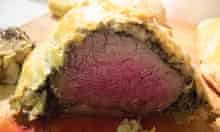
Starting on the outside and working in, I'm surprised to find that, although I've always assumed puff pastry a non-negotiable aspect of a wellington, there are dissenters – possibly motivated by a desire to further Anglicise the boeuf en croute. Most notably, Simon Hopkinson and Lindsey Bareham, who use a "quick flaky pastry" in the Prawn Cocktail Years while conceding that puff is the more traditional choice. (Intriguingly they also suggest brioche dough is a possibility, simply despite following a promising pb for a Julia Child recipe using the very same, I'm unable to observe it in either volume of Mastering the Art of French Cookery – any leads would be well-nigh welcome.)
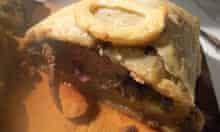
Their flaky pastry is easy enough to make, and the result (buttery, damp with meat juices and meltingly soft, most like a steak pudding rather than a pie) is pop with my wellington panel, but compared to the puff used by Delia Smith, Gordon Ramsay and James Martin, patriotically heavy. We Britons already have our glorious meat pies: let this exist something a trivial more frail.
Madalene Bonvini-Hamel of the British Larder, meanwhile, advocates a rough puff, considering "only the very all-time ingredients will exercise for this recipe" – implying (and rightly so in my opinion) that very few home cooks will accept the patience or the chilliness of hand to do justice to a proper puff.
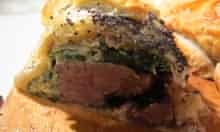
I've made plenty sausage rolls in my fourth dimension that crude puff, with all its meticulous folding and chilling, holds picayune fear for me, but honestly, I think this is ane of those times that but the bouffant lightness of proper puff will cut the mustard. You can brand your own – indeed, for a special occasion, you should give it a go – but with enough other things to think almost, especially at this time of year, I'd be the first to advocate cheating, and using one of the fantabulous ready-made all-butter puffs that take made life so much easier for the pragmatic melt.
The juices
Simon and Lindsey observe in the preface to their beefiness wellington recipe that "the whole indicate of cooking meat in pastry is to keep in the juices ... simply if the pastry is proficient and thin, buttery and rich, nothing is nicer than a meat-soaked crust". I'thou largely with them – afterwards all, using puff pastry should ensure the superlative is still ambitiously lofty, while the base is a melting mass of beefy, buttery decadence – but, as a seasoned MasterChef viewer, I know how much a soggy bottom displeases the highest culinary power in the land (Michel Roux Jr) and I'yard nothing if not aspirational. Pancakes, according to classical lore, volition soak up the meat juices, leaving the pastry unscathed.
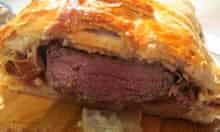
Although, outside MasterChef HQ at to the lowest degree, the concept seems to take fallen from fashion recently, James Martin is still a devotee, prompting me to make four savoury crepes to wrap my beef and mushroom mixture in before I can even begin thinking pastry.
Not only are the cooled pancakes more difficult to ringlet than I'd anticipated, causing my sous chef Richard to pause and watch in horrified fascination before I shoo him out of the kitchen, only the finished outcome is decidedly stodgy. "I just had a chunk of pancake," my flatmate, on her 3rd sample of wellington of the evening, declares, "and now I experience a scrap ill." They're not well-baked like the pastry (which seems just equally moist on the bottom as whatsoever of the other recipes), or meaty like the beefiness – in fact, they're simply an extra layer of carb-laden work. Save that room for more meat.
Actress meat
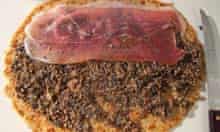
You'll need the extra room too – some recipes, not content with an enormous hunk of beefiness, have to popular some pork in too. Gordon wraps the fillet in pancetta, while James Martin opts for Parma ham. Ham, being leaner and slightly thinner, works meliorate I think, but it's still an unnecessary distraction, given it doesn't seem to exercise anything in the manner of providing a protective seal for the meat juices, as I assume it's intended to. Salty and stridently savoury, information technology steals the thunder from the more delicately flavoured beef.
Fifty-fifty worse, in my panel'southward opinion, is James Martin's inclusion of craven liver pâté – often substituted with pâté de foie gras in yet richer (in every sense) recipes. Liver pâté is not a shy and retiring flavour, and here it reduces the beef to a very expensive vehicle, rather like a protein-enhanced slab of toast. If yous vanquish out for fillet, don't ruin it with additions that are going to bully it into the background.
The mushrooms
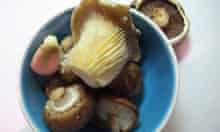
Mushrooms, forth with fillet, are the only aspects of the wellington that will brook no fence. If it doesn't contain fungi, it's a fake. But which fungi? Gordon Ramsay suggests chestnut mushrooms, Simon and Lindsey, and James Martin flat black mushrooms, Delia a mixture of dried porcini, soaked before use, and chestnut, and Madelene a veritable melange of oyster, anecdote, shitake and girolles. I'm unable to lay my hands on any fresh girolles at this fourth dimension of twelvemonth, but I do observe some dried versions that I rehydrate accordingly. Madelene'south fungi feast gets the thumbs up from my testers, who remember that the variety of textures and flavours add interest, and Anna likes the meaty taste of the stale porcini in Delia'south duxelles.
Nearly more important that the variety, all the same, is how the mushrooms are prepared. Both Gordon and the Prawn Cocktail Years pair opt for a very unproblematic duxelles, made by frying finely chopped mushrooms in butter and oil until softened, and then cooking them with white wine and a sprig of thyme until reduced to a thick paste. Information technology packs a surprising flavour punch – I quite like the rougher texture of Gordon's mixture, as opposed to Simon and Lindsay'southward puréed version.
Madelene stirs double cream and a splash of truffle oil into her finished mushroom mixture. Although the oil is judged overpowering, and, like the pâté, has a whiff of gilding the lily about it, the cream gets a mixed reception – I think it detracts from the earthy season of the mushrooms, but Jot likes the richness of information technology.
Like Simon and Lindsey, she uses a chopped shallot in her duxelle, which gives a pleasant sweet – Delia opts for an onion instead, which provokes a tempest of protestation amid the panel. "Is this a pasty?" Anna asks. "It's prissy," Jot concedes, "in the aforementioned way as a steak and onion pie is prissy. But information technology's not as luxurious as the others, where you could taste the mushrooms and the beef – hither it's just onion." After reducing for half an hour on the hob to concentrate the flavours, I'm not really surprised.
Gordon, Simon and Lindsey and the British Larder all use white wine in their duxelles, reducing it down to almost nothing, but giving it a tangy, slightly boozy flavour missing in James Martin's basic duxelles, or Delia's onion feast.
The fat
Delia sears her fillet in dripping, Gordon, James Simon and Lindsey in oil, and Madelene in oil and butter. Oil seems the best choice here – dripping is unnecessarily rustic in season, and there'south enough richness in the residual of the dish to render the butter de trop.
The extras
Delia rubs a decadent drop of brandy into her beef, merely I can't taste it in the finished version, then I make up one's mind to include a drop in the duxelles instead. In fact, after reading so much nearly the Duke's apocryphal tastes, I endeavor it with madeira instead – which is even better. Richer and rounder, and much more 19th century.
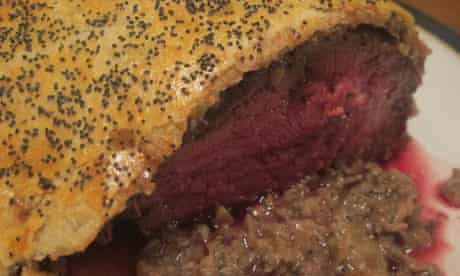
Madelene uses a layer of fair-skinned spinach in her wellington, which is a nice thought – "carbohydrate, protein, sauce and vegetable all in one" as she says – and which wins Richard'due south middle; "it just looks and then pretty" he says dreamily. He's correct, and the fe flavour of the vegetable works well with the beef, only I prefer a more than generous portion of greens on the side. The poppy seeds on the top of her wellington are lovely though – adding a little more crunch, and a decorative flourish to what is, before the large reveal, a large hunk of pastry.
Sauce wise, you could serve a simple beef and ruby wine sauce, but I like Delia'due south proposition of making a sauce with the leftover duxelles – if you serve the wellington with a portion of spinach, it volition bring everything together beautifully. A great one for a fancy wintertime dinner party or even, dare I say it, Christmas dinner?
Perfect beefiness wellington
Serves 4
10g stale porcini mushrooms
50 butter
two shallots, finely chopped
300g mixed mushrooms (eg chestnut, oyster, shitaake, flat black) roughly chopped or torn
1 sprig of thyme, leaves picked
200ml madeira
2 tbsp double cream
250g all-butter puff pastry
1 tbsp vegetable oil
500g beef fillet
1 egg, beaten, to glaze
1 tbsp poppy seeds
i. Preheat the oven, and a blistering sheet, to 200C. Soak the porcini in 150ml boiling water for 20 minutes, then clasp out and finely chop, reserving the soaking water. Meanwhile, melt the butter in a pan over a medium heat and melt the shallots until pale gilt, then add the mixed mushrooms, porcini and thyme and cook until softened. Pour in 150ml madeira, season, turn up the heat and cook until the vino has evaporated. Take off the rut, and scoop ¾ of the mixture into a bowl. Mix in the double cream, sense of taste for seasoning, and set up aside.
2. Heat the oil in a pan over a loftier estrus and, when smoking, add the fillet and sear briefly on all sides until crusted. Season well and allow to absurd. Don't wash the pan yet - you'll demand it for making the sauce.
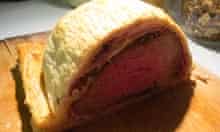
three. Roll out the pastry to a rectangle well-nigh 25cm x 30cm and 3mm thick. Brush all over with egg, and and then spread with the cream duxelle mixture. Put the beefiness at one finish and carefully curl upwardly, positioning it seam-side down, and and then trim the edges and tuck in to seal the parcel, using the tines of a fork to press the edges together. Paint with egg and sprinkle with poppy seeds.
4. Put on to the hot baking sheet and cook for thirty minutes until golden, and so prepare aside to rest for 5 minutes. Meanwhile, make the sauce. Deglaze the beef pan with the remaining madeira and and so add the rest of the mushrooms and the porcini soaking liquid and allow to reduce slightly. Taste, season, and serve with the beef wellington.
Does beef wellington deserve a revival, or does it rest on the award of its luxurious ingredients? Is it the ultimate prove-off beefiness dish, and what else do yous like to cook en croute, or, in plainly English, in a pastry chaff?
Source: https://www.theguardian.com/lifeandstyle/wordofmouth/2011/dec/08/how-to-cook-perfect-beef-wellington
0 Response to "The Beef Wellington Is Not Cooking"
Post a Comment